
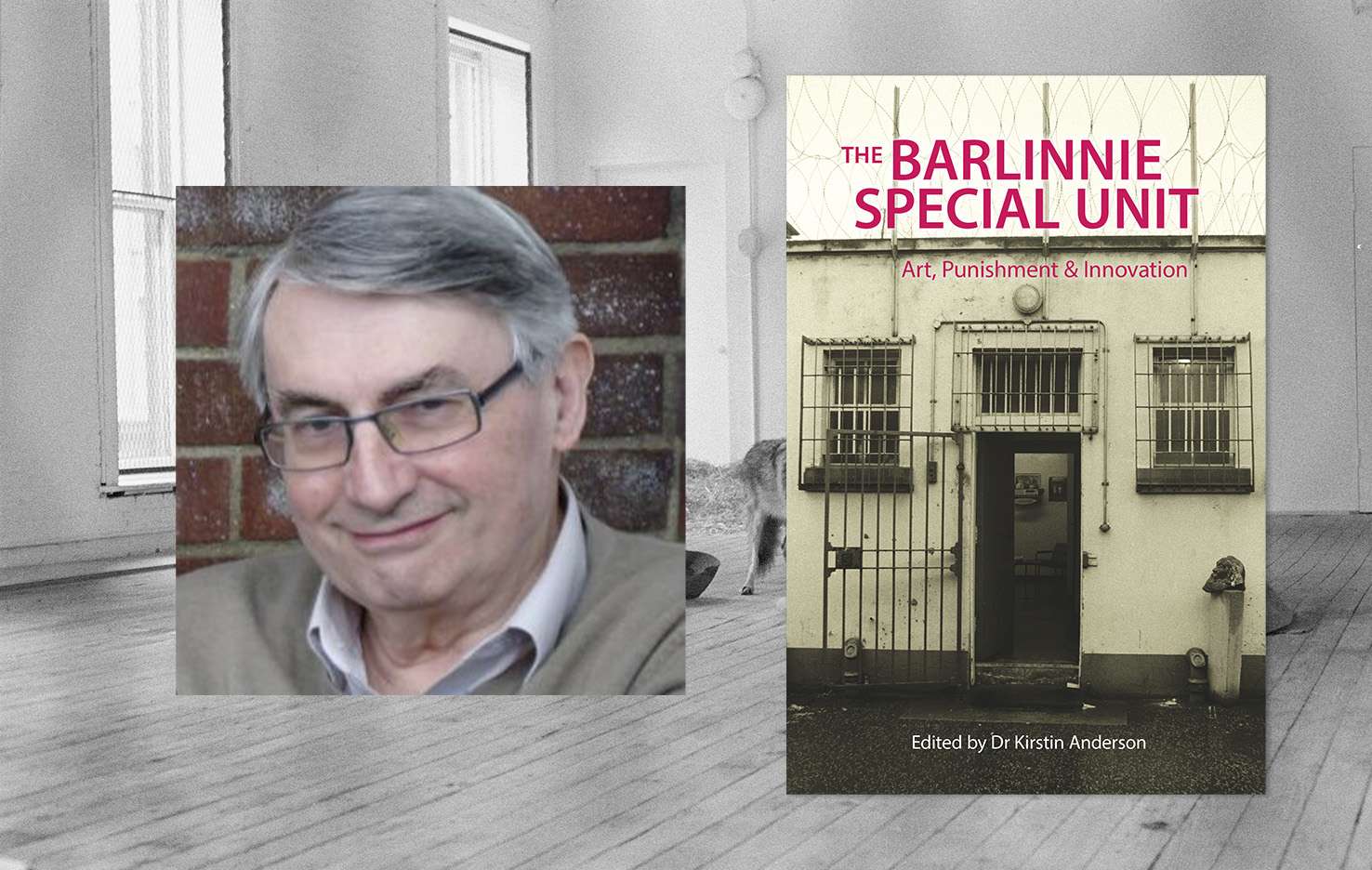
The Barlinnie Special Unit: Art, Punishment and Innovation, edited by Kirstin Anderson (Waterside Press, 2024).
Some Reflections, by Professor Sir Anthony Bottoms, Emeritus Wolfson Professor of Criminology, University of Cambridge.
The Barlinnie Special Unit (BSU), which functioned from 1973 to 1994 in Barlinnie Prison, Glasgow, was an innovative small unit within the Scottish prison system. It attempted to provide a better way forward – both for the system and for the prisoners concerned – for men serving long sentences who, in normal prison locations, seemed to be constantly in conflict with the staff and the system.
In 1982 – while the unit was still in existence – an edited book was published with the title The Special Unit Barlinnie Prison: Its Evolution through its Art (Carrell and Laing 1982). That book was published by the Third Eye Centre in Glasgow (a centre for the creative arts) following its 1980 exhibition of artworks by prisoners in the unit. That this exhibition took place at all was a remarkable fact, both because centres for the creative arts don’t often mount exhibitions of prisoners’ art, and because when the BSU was created in 1973 there was no special focus on art in the unit’s intended regime. Importantly, however, the ‘book of the exhibition’ did not focus exclusively on art in the unit: as its Editors said in their Preface, they also tried ‘to open the locked doors of this unique high security unit sufficiently wide to look both at the day-to-day living and at the wider penological implications of the Special Unit experiment’ (Carrell and Laing 1982, p. 3).
As the Editor and the Editorial Team for this new publication[1] point out in their Introduction, Carrell and Laing’s edited book ‘remains the single most comprehensive record of what the Special Unit’s early days were like’ (p. 24).[2] Indeed, until the present volume there has been no other book that has attempted to provide an overview of the life and work of the unit: there are official reports, prisoner autobiographies[3] and a number of academic articles but there is no further overview volume. A casual observer might think this not very surprising; after all, the focus on art (with its attendant publicity) is generally considered to have been less prominent in the second half of the BSU’s existence, and all of thirty years ago the Scottish Prison Service made a fully considered decision to close the unit. The surprise might rather be that anyone should now think it worthwhile to publish a fresh book on the unit – especially given the small number of men who were ever resident there.[4]
But such a stance would fail to take into account what might be called the ‘mythology’ of the BSU: that is, the fact that significant numbers of people in the prisons world (and not only in Scotland) still talk about the unit – and what they say can and does vary markedly. Given this reality, there was a real need for this volume (which I shall hereafter describe as ‘the BSU book’). Its Editorial Team are to be congratulated on having had the vision to see the need for the book and to bring it to fruition, notwithstanding that it became ‘no mean feat of perseverance and persistence to bring these collected voices together’ (p. 26).
As the phrase ‘collected voices’ indicates, the book contains chapters from a diverse range of people. Some writers or interviewees had a direct involvement in the life of the unit – for example as prisoner, prison officer, prison governor, art therapist, drama producer or researcher. Other contributors offer a variety of valuable wider perspectives on the BSU and its influence: this includes a chapter on how the unit related to the rest of the Scottish prison system; two chapters on how it, and its best-known prisoner Jimmy Boyle, were treated in the Scottish press and other media; several chapters on ‘the arts’ (in a broad sense) in the BSU and beyond; two chapters on how the unit is being archived and commemorated, notably by Glasgow Life Museums; and a chapter on the Gateway Exchange, an innovative community resource for ex-prisoners and others which was established, after his release, by Jimmy Boyle and his psychiatrist wife Sara Trevelyan, demonstrating how the ‘same principles of approach [as those of the BSU] could be applied in a community setting’ (p. 169).
This paper offers a set of reflections on the BSU book, which I have read alongside a re-reading of a chapter on the BSU by my friend Mike Nellis that appeared in a volume presented to me in 2022 (Nellis 2022). Perhaps surprisingly, Nellis’ chapter makes more extensive reference to the material in Carrell and Laing’s (1982) book than do the various chapters of the new book, so there has been real value in considering these two texts alongside one another, especially in the section on ‘BSU and the arts’. I shall also on occasion make some reference to material in Carrell and Laing (1982) to which Nellis does not refer.
It is not practicable, in these reflections, to consider all of the chapters in the new book, so I must apologise in advance to the authors of the less-discussed chapters. My main aim has been to take very seriously what the chapters tell us about the history and functioning of the BSU, and within that framework to reflect on selected issues that are relevant to some contemporary (i.e. twenty-first century) penal concerns. Three such issues are discussed: first, the proposal in the BSU book’s conclusion that further research on the unit is desirable; secondly, how research on the effects of the BSU relates to some more recent research literature on prison regimes; and thirdly, how best to interpret what is known about the role of art in the history of the BSU, and the relevance of this picture for contemporary penologists. The short concluding section is more person-centred; it summarises the views of a prison officer and a prisoner about the positive effects that their time in the BSU had on their later lives.
Further Research on the BSU
In the concluding chapter of the BSU book, Kirstin Anderson and Claire Coia correctly claim that this volume ‘include[s] perspectives not heard before’, but they nevertheless propose that ‘this is not the end of the BSU story … there is still much to explore about the experiences people had in the Special Unit, especially in the last decade of the unit’s operation’ (p. 276).
Research of this kind could certainly be carried out, not least given that recently ‘hundreds of hours of video footage of the unit taken by [two] previous inmates … have emerged’ (p. 254).[5] However, in my view there is a more important topic for further research, which arises from what I have described above as the ‘mythology’ of the BSU.
Let’s explore this ‘mythology’ issue further, by looking at some positive and negative stories about the unit that can be, and have been, told. Some of this duality is well captured by Richard Sparks (Professor of Criminology at Edinburgh University) at the end of his interview for this volume. On the positive side, he says, one might claim that the BSU was:
Daring. And in some ways … [it] unlocked a problem. A small and niche problem in a certain sense, but a serious problem, and in a way that nothing else would have done. And that it had the imagination and the boldness to do that thing (p.196).
He could have added, more technically, that the psychologist David Cooke’s quasi-experimental evaluative research, summarised in his chapter in this volume (ch.12, especially at pp. 174-5) showed that, among BSU prisoners, the levels of both (i) assaults and (ii) other serious breaches of prison rules (e.g. call barricades and ‘smash-ups’) were markedly lower than they had been in standard prison locations earlier in their current sentence.[6] As Cooke puts it, these findings were ‘stark’; hence the unit did indeed, as Richard Sparks put it, ‘unlock a problem’ in a way that nothing else in Scotland had come close to achieving.
But there were also some more negative story-lines expressed about the BSU. One of these focused on issues of fairness vis-à-vis other prisoners, because the regime in the unit was very different from that of other places holding long-term prisoners, most notably in that men in the unit weren’t obliged to work, and the visits policy was exceptionally generous.[7] As Sparks characterised the situation:
It’s always the case within subsystems of education systems or prison systems or hospital systems that the most difficult people get the most resources. … [So BSU prisoners] were getting to see their families all day long. They were getting stuff other people never got. It was difficult for those people to then translate that into saying ‘this reveals some very significant defects in the rest of the prison system that needs to be addressed’. Instead, they tended to say that the Special Unit is an anomaly that can’t be tolerated (pp. 196-197, emphasis added).
Other negative assessments of the unit were more straightforwardly hostile. In his chapter on ‘The Scottish Press and the Special Unit’ Brian Wilson reminds us that in the decades when the BSU was functioning, newspapers had much higher circulations and more political influence than they do now. And as he recounts, after an early and favourable ‘press day’ at the BSU, it wasn’t long before a visit by Jimmy Boyle to the Edinburgh Festival, in his new role as an accomplished sculptor, led to press ‘outrage’ about what ‘the Scottish Police Federation’s spokesman described as “glorification” of “murderers walking the streets”’. According to Wilson, this event set the tone for ‘the negativity that followed’ (p. 215). While most of the press coverage was of ‘legitimate public interest’, nevertheless the ‘whole concept [of the BSU] was so different from what was normally expected and accepted about prisons that it was bound to attract press coverage … However, it was the negative tone of that coverage and the search for fault – fuelled by leaks – which cumulatively made it politically dangerous’ (p. 217).
Wilson’s analysis is echoed and complemented in a chapter by Mike Nellis which considers the ways in which various types of media have reacted to the career – in the BSU and subsequently – of Jimmy Boyle. Nellis, after noting that there ‘were always two parallel versions of the Boyle/Special Unit story’, goes on to characterise the more negative version as one which ‘saw the activities Boyle was permitted to pursue, … the new “artistic” company he kept, the recognition his sculpture and writing achieved and the lifestyle he took up afterwards as proof … of all that was wrong with [the unit’s] indulgent, “liberal” approach to rehabilitation’ (pp. 219-220, emphasis in original). Nellis further argues that ‘over time’, this second version of the BSU story ‘has become the dominant one’ (p. 220), and he concludes by saying that ‘while there was always a personal element in the conservative media attacks on Jimmy Boyle there was also a sense in which they were proxy criticisms of the unit itself, a prison that was not a proper prison, and ought not to exist’ (p. 237).
So what these various accounts have uncovered is: (i) careful research which shows that the BSU generated a significant reduction in violence among its population; (ii) some principled worries about whether the regime was too liberal by comparison with the treatment of those in normal prison regimes for long-term prisoners; and (iii) some reactions of a more populist character about ‘murderers walking the streets’ or ‘it’s just not a proper prison’. All of this reminds those of us who are criminologists that in policy terms it is never sufficient to produce evidence of a programme that ‘works’; we also need to pay attention to how it can be viewed ethically, because if ethical weaknesses can be credibly pressed by critics, this will make that programme potentially politically vulnerable. As the essays in this volume collectively highlight, the BSU provides a vivid illustration of this kind of tension.
This analysis leads me to propose that the most important issue for future BSU-related research would be some further exploration of this tension. I would further suggest that such research might focus on two main topics. The first would be to develop a more detailed account of press and other public representations of the BSU than is offered in the chapters by Wilson and Nellis, crucial though these chapters are in laying out the parameters for a fuller analysis.[8] Then secondly, and of particular importance, I would suggest conducting a study of official decision-making about the BSU in the headquarters of the Scottish Prison Service (SPS) and at ministerial level over the twenty and more years of its existence.[9] While some of the chapters in this volume touch briefly on the role of SPS HQ and the Scottish Office, particularly in the closing years of the unit,[10] they do not pretend to offer any detailed analysis of these matters. But the senior policy-makers in these organisations must have been aware of the competing stories about the BSU outlined above, and it would be of great interest to ascertain in detail how they responded to it. Hopefully – but of course this would depend on what the sources show – such an analysis could be of value for contemporary policymakers facing decisions involving analogous tensions.
The BSU and Prison Studies
Towards the beginning of his interview for the BSU book, Richard Sparks comments that ‘what is sometimes … forgotten, not least by people who have particular interest in the Special Unit from the Scottish perspective, is that there was a small units strategy in England and Wales as well during the 1980s and 1990s’ (p. 184); and he goes on to mention the English report on this topic produced at that time by the Home Office’s ‘Research and Advisory Group on the Long-Term Prison System’ or ‘RAG’ (see Home Office 1987). As Sparks also mentions, two of the members of that Group were the late Roy King and myself, and I well remember some of the discussions – formal and informal – that we had in relation to the Group’s work. As in Scotland, the small units strategy in England at that time was focused on people often then called ‘control problem prisoners’; that is, long-term prisoners whose behaviour in prison consistently caused problems of control for prison staff. Perhaps not surprisingly, many people attributed this kind of behaviour exclusively (or nearly so) to psychological factors in the background of the individuals causing the problems; but Roy King, based on his previous and then-current work in various kinds of institution, quietly but persistently pressed the point that people can and do behave differently in different situations, including different kinds of institutional regime.[11] His advocacy was successful, and it led the Home Office to commission me to lead a research project with the brief ‘to describe accurately and to explain the nature of control problems [in long-term prisons] and the conditions leading to their emergence’. (Notice that this brief required us to focus primarily on institutional environments rather than on individual prisoners). To tackle this, we chose to research two prisons with markedly contrasting current regimes, as well as contrasting past histories of ‘control problems’. The analysis clearly revealed that institutional environments could and did have some significant effects on both the frequency and the character of ‘control problems’ (Sparks, Bottoms and Hay 1996).
David Cooke’s research on the BSU was conducted at about the same time as these developments in England. As we have seen, his quasi-experimental research demonstrated that the violence rates of BSU residents were significantly lower than they had been in previous institutions. But how had this effect been achieved? His answer had some marked similarities to that emerging from the research in England (see above). As he puts it in his chapter in this volume:
It should be self-evident – but it wasn’t – that disturbed, distressed and disordered people are not violent merely because of who they are, but also because of where they are – and how they are treated. There was no silver bullet, no simple explanation. Rather there was a mosaic of situational factors that promoted this change in behaviour. Context matters. … When it comes to understanding violence, unfortunately, context tends to be ignored at the expense of the individual. This is a fundamental attribution error (pp. 175-6, emphasis added).
Cooke goes on to argue that, in the case of the BSU, it was ‘difficult to identify and rank the specific [situational] ingredients that impacted behaviour’ – and indeed that these might have been different for different prisoners. He nevertheless suggests that ‘there can be little doubt that conscious attempts to change staff-inmate relationships were critical’ (p. 176, emphasis added); and he adds that Jimmy Boyle (1977, p. 11) was probably right when he said in his autobiography that ‘the single most important factor of the Unit … was the way staff and prisoners were allowed and encouraged to sit down and talk together’. According to Boyle, this ‘made the Unit unlike any other place’.
I think we might be able to make this line of explanation a little more specific. Elsewhere, I have suggested that ‘situational’ effects on behaviour can be broadly divided into the ‘architectural’ and the ‘social-structural’ (Bottoms 2019b); and on this basis, it is clear that the situational difference between the BSU and ordinary prisons was mainly social-structural. A key social-structural feature of the BSU, perhaps especially in its earlier years, was the adoption of the ‘democratic therapeutic community model’ that had been developed by the Scottish psychiatrist Dr Maxwell Jones and used by him at Dingleton Hospital in the Scottish Borders. In the opening chapter of the BSU book, Sara Trevelyan explains this model (at p. 34). A central component of it was the weekly ‘community meeting’ of all prisoners and staff in the unit which ‘everyone was expected to attend and participate in’. For each such meeting, she continues, there was an elected chairman (who could be either a staff member or a prisoner); ‘each person, staff and prisoners, were asked if they wanted to raise any topics of discussion’; ‘general issues, including the development of the unit’, could also be discussed; and there was also the possibility of calling further, smaller, meetings. Neither BSU prisoners nor staff had encountered anything like this before; it was a key situational change.
For Jimmy Boyle, this structure of community meetings was central to the success of the unit with prisoners. As he put it in an Afterword to the most recent edition of his autobiography[12]:
Although they got some things wrong, the one thing that they got absolutely right, even though we initially hated it, was the insistence that we all sit down in a community and talk things through. In those early days, there would be walls of silence, and frequently some prisoners, and indeed staff, would walk out of these meetings. The thought of sitting down and talking to the enemy was anathema. The chasm of distrust between us was vast. [The meetings structure] was, however, the acorn that was to create the oak (Boyle 2016, p. 300).
Of course, any BSU prisoner who didn’t like the meetings structure (or the unit more generally) could ask to be transferred back to a normal prison (and a few did[13]). But the liberal regime of the unit (see above) offered a powerful incentive to stay, and acceptance of the meetings regime was a requirement if one stayed. Over time, it seems, this brought about some significant change:
… gradually a degree of trust was built amongst staff and prisoners that allowed the previously high walls of defensiveness and mistrust on both sides to break down. In essence, this was an environment which attempted to restore to these seriously institutionalised prisoners a degree of respect and human dignity. This was an extraordinary achievement in itself … (Sara Trevelyan, p. 36, emphasis added).
If Sara Trevelyan’s analysis is correct – as I believe that it probably is – then, using the typology of mechanisms of legal compliance that I set out in Bottoms (2019b), the main eventual mechanism of the BSU men’s moves towards greater legal compliance was normative (being treated with respect and dignity, the development of mutual trust, and the later normative consequences of this). However, and crucially, this normative change was generated gradually by the radically different situational context (the meetings structure and its effects) that were integral to the BSU regime[14] – and that regime was itself supported by the men’s instrumental wish not to return to a standard prison regime.
In the previous section, we noted a comment by Richard Sparks to the effect that one way of responding, in policy terms, to various ‘special’ or ‘liberal’ features of the BSU regime would have been to say: ‘this reveals some very significant defects in the rest of the prison system that needs to be addressed’. During the lifetime of the unit, it seems that responses of this kind were rare. But in light of Sparks’ comment, it’s worth returning to the sentence that I italicised in Sara Trevelyan’s comments about the BSU (see above): ‘In essence, this was an environment which attempted to restore to these seriously institutionalised prisoners a degree of respect and human dignity’. This sentence in effect makes two claims: first, that the prison regimes the men had previously experienced did not treat them with respect and dignity; and second, that when in the unit they were treated with respect and dignity this made a vital difference, including changes in their patterns of behaviour. If these claims are correct, then what we might describe as the ‘Sparks response’ would require us to confront the issue: ‘might the Special Unit’s treatment of prisoners with respect and dignity reveal a significant defect in the rest of the prison system that needs to be addressed?’.
Thirty years after the closure of the BSU, we have some fresh data and theorisation that can help us to address this question more fully than was possible during the unit’s lifetime. This material comes from research, over many years, by Alison Liebling and her colleagues, using an interview schedule known as MQPL or ‘Measuring the Quality of Prison Life’. MQPL generates quantitative data, but it was developed – and subsequently modified – from a qualitative methodology (including creative groupwork and individual interviews) described as ‘Appreciative Inquiry’, in which prisoners in a number of different prisons were asked to reflect upon, and identify, situations and occasions when they experienced the prison most positively. Liebling startled some by insisting that the major initial book arising from this research had the title Prisons and their Moral Performance (Liebling with Arnold 2004); and some years later she summarised the findings of many MQPL studies in the following way:
… prisoners need to feel that they are safe; that they are treated with humanity; that they understand the way that the prison system, including [its] release procedures, works; and that they are in a well-ordered and professional prison where staff have enough experience and expertise to deal with the issues that matter to them[15]; and where staff use both … formal and informal means of authority (including relationships with prisoners) … to maintain order. This is not a ‘heavy’ version of authority. Staff in better prisons use talk, modelling and supportive limit-setting in order to cajole or persuade prisoners into activities that are (usually, in these prisons) in their interests. In other words, the staff are fair, competent, clear and responsive. Not many prisons reach these standards (Liebling 2015. p. 21).
Two points about this quotation have special relevance in relation to the BSU. First, we need to notice that ‘good’ regimes – from the prisoners’ point of view – require staff to act in fair, competent and responsive ways, talking respectfully to prisoners, taking their concerns seriously and modelling appropriate staff behaviour. Although we don’t have much detailed evidence about how staff worked in the BSU, it is very clear from various published memories that the late Ken Murray, a Principal Nurse Officer and Deputy Chair of the Scottish Prison Officers’ Association, played a key role in the early years of the unit in shaping and leading staff behaviour. Appropriately, therefore, chapter 8 of the BSU book contains two essays remembering him: these are written by Jimmy Boyle and by Bill Beech, an arts curator who was a regular visitor to the unit from 1974 to 1982.
The second point to note concerning Alison Liebling’s summary of MQPL research results (above) is that she lists ‘safety’ and being ‘treated with humanity’ as the first two items in that summary. This is no accident, because her research has shown that each of these qualities is fundamental to prisoners’ perceptions of what constitutes a ‘good institution’.[16] In the case of the BSU, safety was not a problematic matter, but – as Sara Trevelyan’s analysis attests – being treated with respect and dignity was absolutely central to prisoners’ eventually positive response to the unit’s regime.
In the various studies by Liebling so far described, when an institution is described as a ‘better prison’, it means that the prison had higher MQPL or ‘moral quality’ scores – in other words, it was better according to the evaluation of the prisoners. Sceptics might not be persuaded by such results, saying that we need to test MQPL scores against more objective data about prison outcomes. Alison Liebling has been sensitive to this line of potential criticism, and has collaborated with her colleague Katherine Auty to conduct two large-scale quantitative analyses of this kind – the first on the relationship between MQPL scores and post-prison reoffending (Auty and Liebling 2020) and the second on the relationship between MQPL scores and a variety of measures of in-prison harms such as serious prisoner-on-prisoner assaults, serious prisoner-on-staff assaults and prisoner self-harm incidents requiring hospital treatment (Auty and Liebling 2024).[17] Briefly, both analyses yielded results in the hypothesised directions. The Abstract of the reconviction analysis states that the ‘findings suggest that higher moral quality of [prison] life, or higher interior legitimacy, supports better outcomes for prisoners on release’. The ‘harms in prison’ paper was able to identify two ‘thresholds’: a lower MQPL threshold below which prisons could be described as ‘unsafe’ in the evaluation of prisoners and a higher MQPL threshold above which they could be described as ‘minimally safe’. Some marked overall differences were found:
[T]he [MQPL] scores of prisons below the lower threshold had a very strong relationship with each of our … serious forms of violence in prison. Similarly, … prisons that had managed to cross the ‘safe’ [MQPL] threshold … were at considerably lower risk of those incidents occurring. … (Auty and Liebling 2024, p. 748).
Striking findings of a more specific character also emerged; for example, using an odds-ratio methodology, prisons that did not achieve a positive rating[18] on the ‘staff-prisoner relationships’ dimension of the MQPL were ‘over 23 times more likely [than other prisons] to have a serious prisoner on prisoner assault, 7.46 times more likely to have a serious assault on staff [and] 7.88 times more likely to have a serious self-harm incident’ (ibid p. 736).
The authors have themselves conducted MQPL surveys in many prisons, often combining them with some limited but intensive qualitative research in the same institution (see for example Liebling et al 2019). Liebling and colleagues have also carried out an in-depth analysis of two high security prisons with contrasting regimes (see Williams and Liebling 2022; a fuller analysis by Liebling will appear in a forthcoming book). These further studies enable Auty and Liebling, in their concluding discussion, to make some judgements that go beyond the findings from their large quantitative dataset:
Prisons with higher dimension scores are not just ‘a bit different’ from prisons with lower scores on a linear scale, they are qualitatively distinct: staff in these prisons demonstrate a fundamentally different approach to their work. They operate with due attention to security and order, but also with positive underlying assumptions about prisoners, punishment and rehabilitation, demonstrating very different dispositions and practices from staff in lower threshold prisons. … Liebling has referred to these differences using Buber’s terms I-It and I-Thou relations (where prisoners are treated as ‘experienced objects’ or ‘experiencing subjects’ respectively: Buber 1970). Staff in I-Thou prisons tend to have much higher levels of experience, training and professional support. The scores reflect real and tangible differences in the moral environment (Auty and Liebling 2024, p. 748). [19]
Like David Cooke in his evaluation of the BSU regime (see note 6 above), Auty and Liebling are aware that researchers need to consider potential alternative explanations of their empirical results. One of these potential alternatives concerns the security category of the prison, because in their large-scale dataset ‘the highest MQPL scores are found in open and Category C prisons’ (Auty and Liebling 2024, p. 731),[20] and prisoners held in such institutions will – on average, and based on their prior histories – have lower statistical risk scores for assault than those held in high security or Category B prisons. However, better MQPL scores can also be found in some higher security prisons; indeed, the in-depth study on which Williams and Liebling (2022) is based showed that two high security prisons had significantly different MQPL profiles, one of which was of an I-Thou character. In light of these various findings, Auty and Liebling (2024, p. 731) are clearly right to propose that ‘continuing efforts should be made to compare moral climates, and a range of outcomes, within security categories’ (emphasis in original), because such studies would provide a better control of antecedent risk. However, this issue is one of refinement and strengthening of the analysis, and it does not detract from the general conclusion that MQPL scores are good predictors of prison-related outcomes. There is therefore a very good case for prison managers to help the officers and other staff in their prisons to model the approach to prisoners that was summarised by Liebling (2015, p.21) (see above).
Some might think that this excursion into an important recent strand of prison studies has not much to do with the BSU. If any do think this, I disagree. To state the matter in the terms of Buber’s dichotomy (see above), it seems clear that in moving from ‘standard’ Scottish prisons for long-term prisoners (such as Peterhead or Inverness) to the BSU, prisoners were moving from a predominantly I-It to a predominantly I-Thou regime.[21] The success of the BSU regime in significantly reducing violent incidents among men with serious ‘control problem’ histories (as shown in Cooke’s longitudinal analysis) can therefore reasonably be regarded as a precursor to the results of Auty and Liebling’s (2024) later analysis of the success of I-Thou regimes in reducing violent incidents in English and Welsh prisons.
Earlier in this section, drawing on an insightful comment in Richard Sparks’ interview for the BSU book, I raised a question that could have been asked during the lifetime of the unit, namely: ‘might the Special Unit’s treatment of prisoners with respect and dignity reveal a significant defect in the rest of the prison system that needs to be addressed?’. Given the findings of Alison Liebling’s research programme, we are now in a better position to answer this question than were the prison authorities during the lifetime of the BSU – and the answer must be a very positive ‘yes’. But it is also of great interest to note that, at that earlier time, some closely analogous thoughts were raised by one of Sparks’ predecessors in the Chair of Criminology at Edinburgh, Frederick McClintock. In his contribution to the book edited by Carrell and Laing (1982), McClintock suggested that, penologically, there were two key issues to consider in relation to the BSU: first, ‘the extent to which this experiment has proved to be a successful method of dealing with the violent and recalcitrant offender’; and secondly, ‘the implications of the experiment for more general developments in the prison system and for penal policy’. Although writing before the publication of David Cooke’s research, as regards the first issue he was satisfied that the unit was a success. But as regards the second issue, he noted with disappointment that in Scotland these ‘wider implications of the innovation … have not been explored’. He added, pithily, that ‘if the behaviour and attitudes of difficult inmates change so rapidly when they are moved from the military-type discipline of the large prison, it should lead to as much criticism against the ordinary prison regime as against the “difficult inmates” within such situations’ (McClintock 1982, pp. 10-11).
In light of these various considerations, evidence about the BSU, despite its historical character, remains fully relevant to contemporary debates about the future of prisons.
The BSU and the Arts
The subtitle of what I have been calling ‘the BSU book’ is ‘Art, Punishment and Innovation’, and this paper began with a reference to the only previous edited book on the unit (Carrell and Laing 1982), the subtitle of which refers to the BSU’s ‘evolution through its art’. However, art has not yet been mentioned in these reflections: why not?
As with ‘the BSU story’ as a whole (see previous discussion), there have been differences in the way that the topic of ‘BSU and the arts’ is addressed. These differences are both descriptive and normative. Descriptively, some have wanted the artistic dimensions of the unit’s life to be prominent in accounts of its history, while others have written about the unit with little reference to the arts. Normatively, some believe that the arts can be of vital importance to rehabilitative programmes in prisons, but others are sceptical about this. For me, such differences of view have a personal element. On the one hand, I would count myself as a penologist, and so I was intrigued to discover that Joyce Laing – a central figure in the story of ‘BSU and the arts’ [22]– once said that ‘the arts do not have a high priority in the thinking of penologists’ (Laing 1982, p. 57). I would have to agree that this is historically a correct statement, not least because penology throws up so many difficult issues about the justification of punishment, whether intendedly deterrent punishments ‘work’, and so on. On the other hand – and as mentioned in the introduction to this paper – my friend and criminological colleague Mike Nellis, for whose work I have great respect, contributed a chapter on the BSU to a volume presented to me in 2022; and this chapter, in his words, ‘seeks to show how creative arts briefly but spectacularly became integral to the concept of offender rehabilitation and, by dint of that, to the always “cultural” politics of penal reform in Scotland’ (Nellis 2022, pp. 305-306). In light of this claim, the role played by the arts in the life of the BSU clearly deserves careful evaluation.
To begin to navigate these potentially choppy waters, a helpful starting point is Joyce Laing’s (1982, p. 57) comment that there are three ways in which the arts can be used in institutional settings. (Note: ‘institutional settings’, not just prisons). One of these ways is as a ‘pleasurable time-filling occupation’; another is as ‘an educational pursuit’. Then, thirdly, the arts can be ‘a living expression of thought, emotion and portrayal of images from the subconscious’. For Laing, the first two ways can certainly bring ‘benefits’, but ‘the arts will not engender change or growth for the individual without the third way, which is the spontaneous expression of the inner psyche’. It can be argued that this is overly dismissive of the second way (education), which undeniably can and does sometimes bring about normative change in individuals, although this often takes time.[23] In order to be inclusive, it therefore seems reasonable to proceed on the basis that, in institutional settings, the arts can contribute to individual change in both the second and third ways that Laing outlines. Turning now at last to penology, since rehabilitation involves a degree of individual change, it follows from the above that the arts can in principle contribute to processes of prisoner rehabilitation, although whether this actually occurs in a given context will be a matter for empirical investigation.
When we examine the history of the BSU, there is no doubt that in the first half of the life of the unit, art was important. In her initial sessions in the unit, Joyce Laing did not make much headway (see ch. 2 of the BSU book), but a breakthrough occurred when Jimmy Boyle decided to try to sculpt with clay, and crafted a small seated figure surrounded by bars (‘Solitary – Inverness’ 1974: see illustration, p. 49). His later sculptures – in various media – were of real quality, as were those of Hugh Collins, and by 1980 there were enough artworks of quality by unit prisoners for the Third Eye Centre to mount its BSU exhibition (see the introduction to this paper).[24] By then Jimmy Boyle had also published an autobiography (Boyle 1977) and the poetry of Larry Winters (1979) had gained attention, both before and after his unfortunate death in the unit in 1977. So according to Claire Coia, writing in the BSU book, in these early years ‘art … became part of the unit’s collective identity, … integral to community life as a focus for individual development’ (p. 51). That might be regarded by some as an exaggerated claim, but it is largely supported by an interview with David Croft (a Principal Officer in the unit 1980-1984), who had no special interest in art:
When I went to the BSU in 1980 almost all of the prisoners were progressing art projects of one kind or another … even I could tell that some prisoners were clearly producing art to a very high standard and others to a good standard. … In my time, almost every prisoner who came to the unit tried art and the ones who didn’t do well quickly moved on to handicraft-type work, things like for example plaster models, chess boards and pieces. … A host of prominent artists from the local community took a great interest in the prisoners’ art work, and regularly visited the unit. This resulted in art and creativity becoming embedded into the BSU’s culture. Allowing prisoners to mix with these artists and to build different relationships in my opinion widened further the social skills of us all (pp. 104-105, emphasis added).
Nellis (2022, p. 317) emphasised – correctly – that all this was ‘unique’:
At no other point in Scottish (or British) history had a penal institution become so identified with the arts, or the rehabilitation of offenders so tied to creative expression. Furthermore, the visible support and encouragement of significant individuals in the Scottish arts community gave the somewhat nebulous penal ideal of rehabilitation a tangibility which it often lacked.
All the above descriptions refer to the arts in the first half of the life of the BSU (i.e. up to 1984, when David Croft left the unit). But what about the second half of its life?
Two chapters in the BSU book yield important data about this later period. There is, first, a chapter by Irvine Allan, now a university drama lecturer but in the early 1990s a drama student who by happenstance was invited to an evening reading of BSU prisoners’ creative writing. This led to his working with BSU prisoners (three in particular are mentioned) to create the ‘Cat A Theatre Company’, which would ‘go on to produce a trilogy of important plays, win awards and receive accolades on both sides of the Scottish border’ (p.150).[25] These successes included ‘a “Fringe First” for Outstanding New Production at the Edinburgh Festival Fringe 1992’ for No Mean Fighter (the first play in the trilogy), which ‘explores the situation leading to the riots in Peterhead Prison in the 1980s, where most of the men in the unit had served time’ (p.150). In the BSU, there seems to have been no special interest in drama before this late development,[26] but these plays must clearly be included in the overall catalogue of artistic expression in the unit.
The second source for the role of the arts in the later years of the BSU is an interview with Richard Sparks by Kirstin Anderson. In this interview, Sparks said that at the time of his research into the unit in 1992, BSU residents ‘mostly didn’t say much about the arts’ and ‘there wasn’t so much of that happening there any more’. However, that did not mean that nothing creative was happening. For example, some prisoners were doing autobiographical work (written or filmed) ‘because there was still quite an active cultural interest in the unit’; one person was ‘extremely interested in ceramics’; and some were ‘keeping pigeons or gardening rather than creative arts as such’ (p.188). He added, more generally, that:
… the people in the unit very much described themselves to me, two or three cases in particular, that they were working on themselves as they saw it. They were trying very consciously to develop and craft a new sense of themselves in a different vision of their future and to signal quite a sharp distinction between their previous lives and the ones that they were hoping to live. And the talking to me, like talking to lots of other people who came in, the unit was part of that. But they weren’t necessarily doing it through painting or sculpture or other artistic production (pp. 188-189, emphasis in original).
From these various accounts, what can be said about differences in ‘arts and the BSU’ in the earlier and later periods of the unit’s life? First and most obviously, there was some change in the kind of artistic activity that was undertaken, with significantly more emphasis on the visual arts (such as sculpture and painting) in the earlier period, and on drama in the later period. Secondly, because of the very high quality of some of the artistic work in the earlier period, there was at that time more external recognition of the unit by prominent people in the arts world. (The later ‘Cat A Theatre Company’ won some awards, but these seem not to have had the cultural reach achieved in the earlier period). Thirdly, and in consequence of the previous two points, as David Croft put it (see above), in the earlier period ‘a host of prominent artists … regularly visited the unit … [and] this resulted in art and creativity becoming embedded into the BSU’s culture’. By contrast, in later years although in Richard Sparks’ words there was ‘still quite an active cultural interest in the unit’, no-one describes art in the unit in the same way that David Croft had.
How should one respond to a narrative account of this kind? Joyce Laing (1982, p. 58), in a comment that is reproduced by Claire Coia on pp. 51-52 of the BSU book, suggested that there might be some dangers associated with the successes of the early years:
From these beginnings of artistic creativity in the Special Unit grew the concern to ease the way for the others to discover creativity within themselves. … Yet if the first creative works are almost too successful and too highly acclaimed they can hamper the endeavours of others by their very success, discouraging them into believing that they could never match such a high standard.
Laing was of course talking about individuals being potentially discouraged, but arguably the collective history of ‘BSU and the arts’ has sometimes been seen in similar terms, i.e. as rather ‘discouraging’ after the initial prominent successes. But is such a stance justified? Undeniably, in the late 1970s and early 1980s the arts had become ‘embedded into the BSU’s culture’, as David Croft put it, and some of its residents had produced work of significant quality that drew praise from creative arts specialists. But this seems likely to have happened as a result of a mix of special factors; in which case, it would be unreasonable to expect the same level of artistic creativity to be reproduced, with a largely different population, in the second decade of the unit’s life. Laing’s main concern as an art therapist was not on future high quality, but rather on what she describes as ‘self-expressive creativity, where the goal is to discover one’s own resources and to use these in self-growth’ (Laing 1982, p. 59). Nellis’ important 2022 paper is primarily about the early years of the unit, but he does briefly comment that ‘[a]part from Collins’s sculpting, the Unit’s later artwork was more akin to that of a traditional prison education department’ (Nellis 2022, p. 320). It’s not clear how he evaluates that situation, but it is important to note that such an assessment could be fully compatible with Laing’s prioritisation of opportunities and encouragement for prisoners to develop ‘self-expressive creativity’.
There is also, it seems to me, a further problem in accounts of the BSU that strongly emphasise differences between its earlier and its later years; namely, we have evidence of one very important similarity between these two periods. Recall that Richard Sparks described the prisoners he interviewed as, in particular, trying ‘to develop and craft a new sense of themselves in a different vision of their future’ (p.188). He was of course describing the later period, but these words could, I think, also be applied to much of the work undertaken in the earlier period by prisoners who worked with the visual arts, with poetry and with autobiography – they too, surely, were working on fashioning a new sense of themselves.[27] If that inference is correct, there is a real congruence between the earlier and later years of the BSU. And here – since in talking about the BSU we are inevitably talking about a penological project – we also have to notice that to speak of prisoners trying to ‘craft a new sense of themselves’ is, very clearly, to speak of a process of attempted rehabilitation. [28]
At this point, we can usefully explore some possible connections between this discussion and aspects of the argument in the previous section, especially the data that show positive consequences from the adoption of I-Thou prison regimes, and the suggestion that the BSU regime was I-Thou. In note 19 above, Edward Kessler’s (2013, p.192) characterisation of I-Thou human relationships was cited: ‘one should approach the Other with respect and restraint so that the validity of the Other’s centre is in no sense belittled’. If the staff of a prison are ‘not belittling’ the ‘centres’ of the prisoners in their charge, they will want those prisoners to flourish; that is to say, they will want them to come to terms with their present situation and to develop plans, and perhaps new interests and/or skills, that can lead them towards a better future. Those new interests and skills can certainly include artistic expression of various kinds, and prison managers should be aware of, and sensitive to, this point. But each person is unique, so the paths that different people will choose for their development will undoubtedly, and rightly, be varied. In the BSU, the evidence seems to be that both ‘early’ and ‘late’ prisoners in the unit were actively ‘working on themselves’, but often in different ways. Ethically, and therefore also in penological terms, we should give equal respect to each of these ways.
What is the relevance of the discussion in this section for wider debates about the arts in prisons? I-Thou prison regimes will want prisoners to flourish, and the history of the BSU provides ample evidence that artistic expression is one way (not the only way) in which they can be helped to flourish. But for new interests or skills to be developed, there must of course be opportunities to learn and practise them. Several contributors to the BSU book (e.g. Kirstin Anderson, pp. 272-273) make the valid point that because of, for example, the largely unstructured regime and the part-time presence of an art therapist, BSU prisoners had significantly more such opportunities than do most prisoners. This raises questions about the extent to which normal prisons can offer artistic (and related) opportunities; but this is a topic that is well beyond the scope of these reflections, not least because it has significant cost implications.[29] But I think we can confidently say that the work that Joyce Laing began in the BSU has ensured that the arts now have – and rightly have – a higher place in the thinking of penologists than they did at the time when she made her dismissive comment about them.
Conclusion
In drawing these reflections to a close, I want to re-iterate something that I said in the Introduction, namely that there was a real need for this fresh volume on the BSU. The volume contains much fresh material about the unit, and the hope of the Editorial Team that the book will become ‘a catalyst for questions and conversations’ (p.24) will surely be realised. This paper has focused on three topics that might, I hope, be part of those fresh conversations, but of course it does not exhaust what might be said about them. In summary, I have argued that:
- The most important topic for future research on the BSU would be further analyses of the tension between its rehabilitative success and the suspicion and hostility that it aroused. A better understanding of how SPS Headquarters and the (then) Scottish Office responded to this tension seems vital.
- The BSU was an early example of a prison regime that was based on what Alison Liebling has described as I-Thou principles. For this reason, evidence from the history of the BSU can appropriately be utilised in contemporary debates about the future of prisons.
- Whilst there have been various debates about ‘the BSU and the arts’, arguably the most important point to emerge is that, at different times in the unit’s history, most of its prisoners were in different ways trying, as Richard Sparks put it, ‘to develop and craft a new sense of themselves in a different vision of their future’. This was sometimes, but by no means always, done with the help of artistic expression. Encouraging prisoners to work in this way on ‘a different vision of their future’ makes admirable sense as a penological principle.
But I want to end these reflections on a more person-oriented note. It is true, of course, that existing histories of the BSU often focus on key individuals such as Jimmy Boyle and Ken Murray; but one of the strengths of the BSU book is that it contains interviews with or a chapter written by three members of the BSU community whose voices have not previously been heard. They are: ex-prisoner Johnny Steele; Governor Dan Gunn; and Principal Officer David Croft. The personal reflections of these individuals are important and illuminating, and here I want to focus especially on the thoughts of David Croft and Johnny Steele about the impact that being part of the BSU community had on them.
Like all officer members of the BSU (but not its Governors!) David Croft volunteered to join its staff. Initially, he wondered about the reality of the concept of ‘community’ that was so often used about the unit, but soon:
I was hit by the realisation that I never had the communication skills that everyone else seemed to have. As a community, they had a sort of cultural language they would use to talk about corporate responsibility and commitment to ‘the community’ and its ‘norms’. It was a community, a very close community …(p. 98)
In community meetings, ‘staff being openly confronted by prisoners or their colleagues … was a completely new experience, one that in the early days could make one feel humiliated and weak’ (p. 101). This was challenging, because as a Principal Officer ‘in uniform and wearing pips, … anywhere else I would be a figure of authority’ (p. 100). More generally in the unit, ‘the human dynamics were in many ways very intense and they affected staff and prisoners equally’ (pp. 100-101); as a consequence, ‘some staff found it all too much and left the unit well before their due date’ (p. 100). Yet despite – or perhaps because of – these challenges, for David Croft the ‘Special Unit was certainly the place throughout my career – and I worked in many prisons – that developed me most as a person and as a prison professional’ (p.96). During his years there, he had:
learned so much, particularly in how to communicate with staff and prisoners in potentially volatile situations … [Also] I became more confident in standing up for what I believed to be in the best interests of staff and prisoners and to challenge what I considered to be non-progressive thinking (p. 107).
Croft then gives an amusing example of this last point.
Johnny Steele’s pre-BSU history certainly looked like that of a ‘control problem prisoner’; indeed, he tells us that the Governor of Peterhead ‘informed me that I was … the most punished and disruptive prisoner in the penal history of Scotland’ (p. 113). Originally sentenced to 12 years imprisonment, his involvement in two riots and an escape attempt meant that he lost all the potential remission (four years) from that sentence, and also received a further three years, to be served consecutively. In 1986, he was offered and accepted a place in the BSU, where – as we have seen in note 21 above – he was initially bewildered by the ‘dignity’ with which he was treated. Relationships within the unit, and the regular visits he received from family members, meant that he began to build up his confidence. He then says that he hadn’t lost ‘the fight in me’, but he ‘learned to use my tongue as a weapon’, so ‘often at the weekly meetings I would raise the subject of the brutal regime back in the [Inverness] Cages’ (p. 115). Interestingly, too, although he came to the unit in its second decade, he did try sculpture, and created ‘The Burden’, an almost life-size figure ‘on bended knee with a very, very large ball and chain on its shoulders and chain and bracelet attached to a leg’.[30] But this was not his primary project while in the unit; for that, he worked ‘on an almost daily basis’ with a London filmmaker who was ‘interested in my past lifestyle in prison and wanted me to use my songs and verse to produce a prison musical’. As part of this project, he believes that it was ‘a first in British penal history for me to have access to my own video-recording equipment’ to use in the unit (p. 117; on video-recording see also note 5 above).
Johnny Steele ends his chapter as follows:
I guess I owe my life to the prison officers and friends at the BSU for all their help without which I know I’d be dead. My life had been restored to me in instalments whereas in other parts of the system our lives were taken away from us in one go. For me, the BSU was the only port in the storm (p. 118).
At the beginning of the BSU book, there is a set of brief notes about the contributors to the volume. The entry for Johnny Steele ends by saying that ‘he now lives in the Scottish Borders with his partner and two beautiful daughters’ (p. xviii).
Two men, on opposite sides of the prison officer/prisoner divide – yet both were influenced by and grateful for their experiences in the Barlinnie Special Unit. Their comments echo those of others previously published, and collectively these testimonies undeniably constitute an impressive legacy for the unit to have left.
But we also have to be realistic about the fact that the Scottish Prison Service decided in 1994 to close the unit. In his chapter on ‘The Genesis and Legacy of the BSU’, Andrew Coyle (Emeritus Professor of Prison Studies at London University) argues that in its later years the unit had lost much of its former character as a ‘vibrant community’ (p. 206) – a judgement that has some affinity with Richard Sparks’ comment that one ‘main finding’ of his SPS-commissioned research on the BSU in 1992 was that ‘the SPS had produced a kind of stalemate with the prisoners’ (p.192).[31] In the light of such assessments, the closure decision becomes more understandable, whether or not one agrees with it. But Coyle also outlines, and is highly critical of, the later (post-closure) policies of the SPS in relation to control-problem prisoners. As he puts it, ‘for the last 20 years a handful of prisoners who cannot be held in general accommodation … have been held for extended periods in what amounts to solitary confinement, transferred regularly between prisons from one segregation unit to the next’ (p.210). Reflecting on these policies, he concludes that: ‘sadly, it would appear that the legacy of the Barlinnie Special Unit has been erased from the institutional memory of the …Scottish Prison Service’ (p. 211).
It is greatly to the credit of ‘the BSU book’ that it invites us all to look again at the history of the unit, including both its achievements and its weaknesses, thus ensuring that memories of it will be retained. And Andrew Coyle is surely right to suggest that those memories will contain some lessons of enduring value for all those who care about prison policies.
References
Auty, K.M. and Liebling, A. (2020) ‘Exploring the Relationship between Prison Social Climate and Reoffending’, Justice Quarterly 37 (2), pp. 358-381.
Auty, K.M. and Liebling, A. (2024) ‘What is a “Good Enough” Prison? : An Empirical Analysis of Key Thresholds using Prison Moral Quality Data’, European Journal of Criminology 21(5), pp. 725-753.
Bottomley, A.K., Liebling, A. and Sparks, R. (1994) Barlinnie Special Unit and Shotts Unit: An Assessment. Edinburgh: Scottish Prison Service Occasional Paper 7/1994.
Bottoms, A.E. (2019a) ‘Penal Censure, Repentance and Desistance’ in A. du Bois-Pedain and A.E. Bottoms (Eds.) Penal Censure: Engagements Within and Beyond Desert Theory. Oxford: Hart Publishing.
Bottoms, A.E. (2019b) ‘Understanding Compliance with Laws and Regulations: A Mechanism-Based Approach’ in M. Krambia-Kapardis (Ed.) Financial Compliance: Issues, Concerns and Future Directions. Cham, Switzerland: Palgrave Macmillan.
Boyle, J. (1977) A Sense of Freedom. Edinburgh: Canongate.
Boyle, J. (1985) The Pain of Confinement: Prison Diaries. London: Pan Books.
Boyle, J. (2016) A Sense of Freedom, including new Afterword. London: Ebury Publishing.
Buber, M. (1970) I and Thou, translated and edited by W. Kaufmann. New York: Charles Scribner’s Sons.
Carrell, C. and Laing, J. (Eds.) (1982) The Special Unit Barlinnie Prison: Its Evolution through Its Art. Glasgow: Third Eye Centre.
Collins, H. (1997) Autobiography of a Murderer. London: Macmillan.
Collins, H. (2000) Walking Away. Edinburgh: Canongate.
Cooke, D.J. (1989) ‘Containing Violent Prisoners: An Analysis of the Barlinnie Special Unit. British Journal of Criminology 29 (x) 129-143.
Cooke, D.J. (1997) ‘The Barlinnie Special Unit: the Rise and Fall of a Therapeutic Experiment’ in E. Cullen, L. Jones and R. Woodward (Eds.) Therapeutic Communities for Offenders. London: Wiley.
Home Office (1987) Special Units for Long-Term Prisoners: Regimes, Management and Research, a report by the Home Office Research and Advisory Group on the Long-Term Prison System. London: H.M.S.O.
Kessler, E. (2013) Jews, Christians and Muslims in Encounter. London: SCM Press.
King, R.D. (1991) ‘Maximum-Security Custody in Britain and the USA: A Study of Gartree and Oak Park Heights’, British Journal of Criminology 31(2), pp. 126-152.
King, R.D., Raynes, N.V. and Tizard, J. (1971) Patterns of Residential Care: Sociological Studies in Institutions for Handicapped Children. London: Routledge.
Laing, J. (1982) ‘The Role of the Arts in the Special Unit’ in C. Carrell and J. Laing (Eds.) The Special Unit Barlinnie Prison: Its Evolution through its Art. Glasgow: Third Eye Centre.
Liebling, A. assisted by Arnold, H. (2004) Prisons and their Moral Performance. Oxford: Oxford University Press.
Liebling, A. (2015) ‘Description at the Edge? : I-It/I-Thou Relations and Action in Prisons Research’, International Journal for Crime, Justice and Social Democracy 4(1), pp. 18-32.
Liebling, A., Laws, B., Lieber, E., Auty, K.M., Schmidt, B.E., Crewe, B., Gardom, J., Kant, D. and Morey, M. (2019) ‘Are Hope and Possibility Achievable in Prison?’, Howard Journal of Crime and Justice 58 (1), pp. 104-126.
McClintock, F.H. (1982) ‘The Penological Significance of the Special Unit’ in C. Carrell and J. Laing (Eds.) The Special Unit Barlinnie Prison: Its Evolution through its Art. Glasgow: Third Eye Centre.
Nellis, M. (2022) ‘Creative Arts, Offender Rehabilitation and Penal Reform: Remembering the Early Years of the Barlinnie Special Unit’ in A. Liebling, J. Shapland, R. Sparks and J. Tankebe (Eds.) Crime, Justice and Social Order: Essays in Honour of A.E. Bottoms. Oxford: Oxford University Press.
Sparks, R. (2002) ‘Out of the “Digger”: The Warrior’s Honour and the Guilty Observer’ Ethnography 3(4), pp. 556-581.
Sparks, R., Bottoms, A.E. and Hay, W. (1996) Prisons and the Problem of Order. Oxford: Clarendon Press.
Williams, R. and Liebling, A. (2022) ‘Do Prisons Cause Radicalization?: Order, Leadership, Political Charge and Violence in Two Maximum Security Prisons’, British Journal of Criminology 63(1), pp. 92-114.
Winters, L. (1979) The Silent Scream: Poems and Prose. Edinburgh: Polygon Books.
[1] Kirstin Anderson is the volume’s Editor. She was supported by five colleagues, some with longstanding connections to the Unit, whose idea the book had originally been. The Editorial Team comprised Bill Beech, Claire Coia, Mike Nellis, Sara Trevelyan and Rupert Wolfe Murray.
[2] Page references with no further identification will always refer to pages in the new volume on the BSU.
[3] The autobiographies are by Jimmy Boyle (1977, 1985, 2016) and by Hugh Collins (1997, 2000).
[4] The unit’s average daily occupancy was eight or less; moreover, men frequently spent several years there. A research report compiled in 1992 (just over two years before closure of the unit) noted that a total of 35 men had by then been prisoners in the unit (Bottomley et al 1994, p. 16).
[5] One of these video-creating prisoners is Johnny Steele, whose experience in the BSU is discussed in the conclusion to this paper.
[6] It is important to emphasise this result, because it is sometimes said that the unit was not rigorously researched. David Cooke has addressed this criticism as follows: ‘without a control group, and random allocation to either treatment or control conditions, it is harder to argue that the unit as such produced the reduction in assaults. But in reality, sometimes real-world research cannot be squeezed into rigorous experimental designs. This was a case in point. Fortunately, there are other methods – quasi-experimental methods – based on logic and analysis that can evaluate other competing explanations for the observed reduction in assaults. I applied these methods; it was possible to exclude other explanations’ (p. 175). For publications resulting from this kind of analysis see Cooke (1989) and (1997).
[7] Visits by the men’s families and friends were allowed every day from 8am to 10pm and visitors were not searched before or after the visit (p. 115); also, within the unit, residents could take visitors into their cells. Interestingly, in her chapter on ‘The BSU as a Therapeutic Community’ (the conceptual framework underpinning the unit, discussed more fully below), Sara Trevelyan comments that ‘the extremely liberal visiting policy had the potential to allow inmates to “hide”, isolating themselves with their visitors in their cells rather than participating in the active life of the community’ (pp. 38-9).
[8] A fuller analysis of the Scottish press coverage would be of special significance, because Wilson’s chapter is short, and not based on detailed content analysis. Some additional information about press coverage in the early years of the unit is provided in a chapter by Martin Dowle of The Scotsman in Carrell and Laing (1982).
[9] As the BSU was closed more than thirty years ago, all official files relating to it should be searchable in the U.K. Public Record Office. Because closure took place before Scottish devolution, the files are presumably held among the papers of the U.K. Scottish Office.
[10] For example: (i) Dan Gunn (Governor of BSU 1988-91) says that SPS HQ Operations ‘wanted … never to hear of or from me while in post’ (p. 137) and that the job of his successor (appointed 1991) was ‘to wind [the unit] down’ (p. 145 – although NB closure did not happen until 1994); (ii) Richard Sparks (author of a research report on the BSU, commissioned by the SPS in 1992 and delivered in January 1993 but not published until August 1994) comments negatively on that experience (‘I felt that the work that I’d done had been used by other people, but in ways that were not acceptable to me’: p.194) and remarks more generally that ‘there was always ambivalence about Special Units elsewhere in the SPS, including a certain amount of outright hostility to them’ (p.193); and (iii) Andrew Coyle (sometime a Governor within SPS but later a Professor of Prison Studies) offers (on p. 207) some tantalising fragments of evidence about SPS decision-making in the years 1992-4 : in 1992 the immediate past Director of SPS wrote that ‘the BSU was and is ahead of its time’, although ‘its impact … will always be relatively limited in relation to the problems of the SPS’; but then ‘within a year or so there had been a radical change of personnel at senior levels in the Scottish Office and the SPS … the BSU was not part of their vision for the future’; yet in 1994 the Secretary of State for Scotland said that the closure of the unit was ‘not desirable’, but he simultaneously appointed a working party on the BSU and the conclusion of that group was ‘stark: the BSU should be closed’.
[11] As the obituary of Roy King on the website of the Cambridge Institute of Criminology has well said: ‘how residents in institutions respond to the regimes to which they are subject was the sociological question he addressed throughout his career’. This began with his Ph.D. work, incorporated in the volume Patterns of Residential Care (King, Raynes and Tizard 1971), but was thereafter focused on prisons. At the time of the RAG discussions, King was particularly interested in what was described as ‘New Generation Architecture’ in prisons: he was conducting research in a prominent new maximum-security prison of this type in the USA (Oak Park Heights Prison, Minnesota), with a parallel study, using the same research instruments, in an English high-security prison without ‘new generation’ features (Gartree). When published, this research (King 1991) found that – as the Abstract put it – Oak Park Heights was ‘perceived to be safer, more secure and more trouble-free’ than Gartree.
[12] This quotation is included, and its importance emphasised, in the conclusion to Mike Nellis’ chapter in the BSU volume (p. 238).
[13] One such prisoner was Ben Conroy, one of the first to join the BSU. He left the unit after eighteen months but later regretted this decision. After his eventual release, he faced significant difficulties, so he began to make visits to the BSU; he later said that he ‘found that this was the only place I could go to really talk out my problems’ (Carrell and Laing 1982, pp. 24-25).
[14] The hoped-for normative dimensions of the therapeutic community model were well captured by Keith Wardrop, consultant psychiatrist to the BSU in its early years (until 1978). Writing in Carrell and Laing (1982, p. 26), he said that: ‘The underlying principle … is to create a social milieu in which an individual, who has hitherto rejected and been rejected by society, can firstly be accepted, secondly begin to form a social identification with the community, and thirdly begin to develop a sense of social responsibility towards the community. … The aim is to promote social growth of the personality’.
[15] ‘Issues that matter to them’ very much includes, for most prisoners, issues connected with their families and with their own potential futures.
[16] Indeed, elsewhere she has written that ‘all attempts to measure prison quality tend to include at least the three broad dimensions critical to prison life of ‘relationships’, ‘personal development’ and ‘order and organisation’; these dimensions are broadly related to humanitarian, rehabilitative and custodial goals respectively’ (Auty and Liebling 2024, pp. 728-729).
[17] Because the Prison Service for England and Wales has for some years conducted its own MQPL analyses of selected prisons, the total number of such surveys that have been conducted is now substantial. Thus, the research described in Auty and Liebling (2020) was based on 224 prison surveys involving 24,500 prisoners; that described in Auty and Liebling (2024) was based on 518 surveys involving 55,660 prisoners. In addition to the three harm measures described in the text, the second analysis also examined the much smaller numbers of self-inflicted deaths and of prison homicides.
[18] MQPL interview schedules contain questions which uniformly use a 5-point Likert scale ranging from ‘strongly agree’ to ‘strongly disagree’. ‘Mean scores over a threshold of 3.05 are considered to represent an overall positive view for that dimension considered as a whole’ (Auty and Liebling 2020, p. 66).
[19] Martin Buber (1878-1965) was a distinguished Jewish philosopher-theologian. In Auty and Liebling’s text, the characterisation of Buber’s ‘primary words’ of I-It and I-Thou is necessarily compressed, and a much fuller account will appear in Liebling’s forthcoming book. Here, it can be noted that Buber’s analysis is not restricted to human encounters but aims also to encompass how human beings relate to material things and to God. As regards human encounters, it is perhaps easy enough to see that in I-It encounters, the Other is not treated as fully human. This might be simply because of the character of the interaction (e.g. a brief conversation with a shop assistant while buying something) but it can also occur in more extended relationships, for example if A ‘uses’ B to achieve A’s goal or simply regards B as a nuisance. By contrast, forhuman encounters to be characterised as I-Thou, the ‘two people must meet as two valid centres of interest. Thus, one should approach the Other with respect and restraint so that the validity of the Other’s centre is in no sense belittled’ (Kessler 2013, p.192). Note that it is possible to meet this test in professional relationships (e.g. prison officer-prisoner) as well as in more personal ones.
[20] In the England and Wales prison system, adult males are placed in prisons on a descending A to D scale, where A = a high security prison and D = an open prison.
[21] The change is expressed as follows in a chapter in the BSU book by Johnny Steele, describing his introduction to the unit: ‘I was told that should I feel uncomfortable for any reason I should talk to someone or call a meeting to help resolve any problems. I was amazed to discover that so much help was at hand here with everyone eager to help. I wasn’t used to this kind of dignity and it messed with my emotions’ (pp. 114-115, emphasis added).
[22] Joyce Laing (1939-2022) was an art therapist who had previously worked in a psychiatric clinic and in a Young Offenders Institution (Polmont) (p. 46). Early in the life of the BSU she was invited by its first Governor, George Duncan (who had previously been the Governor of Polmont: p. 85) to explore the possibility of working in the unit. Much flowed from that invitation, as is explained in ch. 2 of the BSU book, which is written by Claire Coia but is based on two interviews with Joyce Laing in 2016 and 2021.
[23] Joyce Laing (1982, pp. 57-58) wrote that in the early days of the BSU, ‘had the arts been programmed as an educational pursuit not one of the inmates … would have agreed to embark on such a course’, because of their ‘distaste’ for teaching situations based on their memories of school. Rather, ‘the fragile embryo of creativity … had to be left to grow at its own pace’. This is entirely credible as regards the BSU population. However, it does not follow that educational classes in the arts, leading to some normative change, are an impossibility in prisons, or in other institutional settings.
[24] Nellis (2022, p. 315) gives details of Jimmy Boyle’s rapid rise to fame as a sculptor (from 1974), citing various exhibitions and commissions. He also cites the 1982 view of the art critic of The Guardian that the sculpture of Hugh Collins was ‘in a class by itself so far as the Special Unit is concerned’ (p.319). The Third Eye Centre’s 1980 exhibition, and their 1982 book, included work by Bob Brodie and Tom Galloway as well as by Boyle and Collins.
[25] Central to these developments was the guiding hand of Willy Maley (later Professor of Renaissance Studies at Glasgow University) who was, at the time, a part-time ‘writer-in-residence’ at the BSU. Irvine Allan also records that he recruited some fellow drama students to participate in the plays alongside prisoners.
[26] In Carrell and Laing (1982, p. 39), a list of artistic pursuits taken up by BSU inmates by that date includes creative writing and poetry, but not drama. (The full list is: drawing, painting, stone and metal sculpture, wood-carving, ceramics, creative writing, poetry and music – piano, guitar and mandolin). Some prisoners in these earlier years did however experience some drama, because ‘a prominent theatre company’ came to give a performance at an arts festival held in the unit (p.27).
[27] This suggestion is supported in a description by Joyce Laing of Jimmy Boyle’s reaction after making his initial Solitary – Inverness sculpture (see above): ‘Two parallel emotions were engulfing him; he was bursting with enthusiasm for ideas which he wanted to try with this material which was new to him and he was also experiencing a new concept of the self: the former hard man spending his time working on art’(Laing 1982, p.58, quoted in Nellis 2022, p. 314; emphasis added).
[28] On this point, see also my analysis of ‘the repentance debate’ in penal philosophy, and the suggestion that repentance can be seen as a process of ‘turning around’: Bottoms (2019a). Sparks’ phraseology is very close to a description of people consciously trying to turn their lives around.
[29] As regards these wider issues, see the discussion in ch. 20 of the BSU book by Kirstin Anderson, titled ‘Arts in Prison: Research, Tensions and Prospects’. See also the interesting chapter (ch. 19) by Graeme Brooks, describing the ‘Graft Studio’ in HM Prison Humber (England) which in 21 years has provided artistic facilities to ‘probably over a thousand’ participants. Brooks claims that ‘when new starters arrive at the door’ of the Studio, ‘they quickly realise that they are stepping into a totally new and different environment … [and] we never tire of witnessing the dramatic relaxation of body language, facial features and guard’ that they show (pp. 265-266).
[30] Steele makes no claim about the artistic merits of this sculpture, but he does recount a story about it being borrowed by a political activist and displayed in a square in central Glasgow during a week-long protest against the poll tax, with the revised title ‘The Burden of the Poll Tax’ (pp. 117-118).
[31] As indicated in note10 above, the report on this research was delivered in January 1993 but not published by SPS until August 1994 (see Bottomley, Liebling and Sparks 1994). In a retrospective reflection on these events, Sparks (2002, p. 571) described the ‘stalemate’ situation as one where ‘the immovable object of eight men long practised in obduracy had met the irresistible force of the Scottish parole system’. The view of SPS and the Scottish Parole Board was that after their time in the unit, men should be transferred to another prison to test the change that they had made in the BSU. By contrast, the men thought they should be eligible for parole directly from the unit. In his interview for the BSU book, Sparks explains the men’s view: ‘they had gone to the Special Unit and retired as big time prisoners and couldn’t face the idea of going back because there were younger, tougher people there … [they] were actually quite fearful of [it] ’ (p. 192). Andrew Coyle adds that the 1994 Bottomley et al report, while not regarding closure of the BSU as a serious option, nevertheless identified ‘the Unit’s unsatisfactory interfaces with the mainstream system’ as a ‘pressing issue’ (p.207 n. 11).

The Barlinnie Special Unit
Art, Punishment and Innovation
Edited by Kirstin Anderson
Foreword by Baroness Helena Kennedy